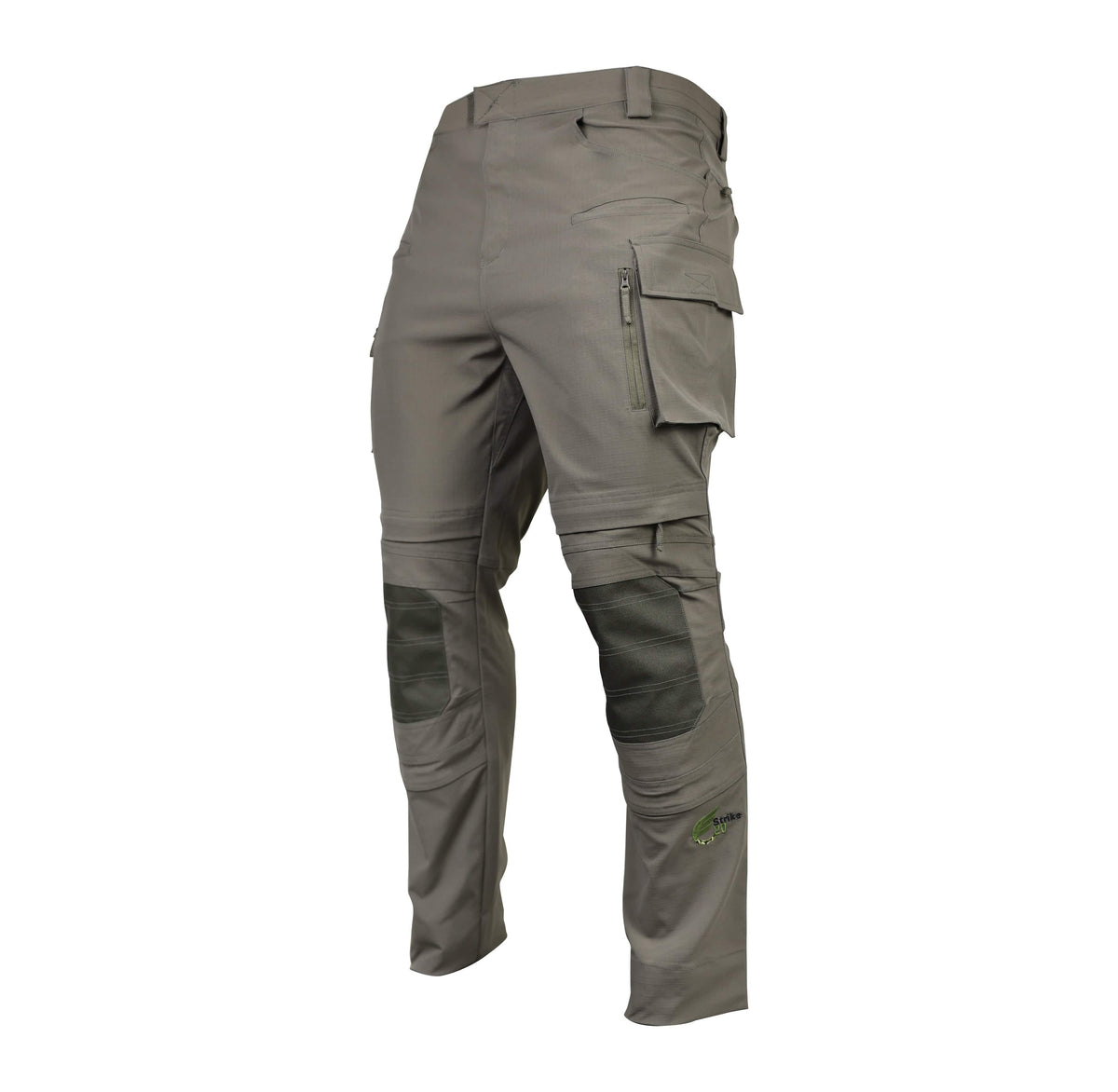

Cargo pants are defined by their extra leg pockets. Tactical pants describe a broader approach to clothing for carrying equipment and moving through a working day. The categories overlap: a pair can be both. Neither label tells you whether the pockets, cut or fabric will suit you.
The useful comparison is between two actual pairs. Start with what you carry and how you move, then decide whether a feature earns its place. A well-fitting pair of cargo trousers may cover everything you need. Tactical features become useful when they solve a specific problem.
What the labels tell you
Cargo pockets add storage on the legs. Their position, size and closures vary, so the word “cargo” alone says little about what you can comfortably carry.
Tactical designs may add features such as reinforced areas, shaped knees, extra panels for movement or pockets arranged for particular items. These are features to verify on the individual pair, not a checklist every tactical garment meets. Manufacturer guides such as First Tactical's pants guide describe these construction choices. 5.11's cargo collection includes tactical designs, illustrating the overlap.
Use the labels to find options. Use the details below to choose between them.
Match the trousers to your day
Pick the situation closest to yours and identify one problem your next pair needs to solve.
Mostly sitting with short walks
Start with the waistband and the pocket holding your phone. A phone may fit while you stand but press into your thigh when you sit. Check whether you can take it out without lifting yourself off the chair. A long pocket list is less useful than a comfortable place for the things you reach for often.
Repeated bending and carrying small items
Check room through the seat and thighs, then where a notebook, keys or compact torch will sit. Look for a cut that lets you bend without the waistband pulling down. Compare pocket closures and access with your usual belt in place. More fabric in the waist does not necessarily solve tightness elsewhere.
Walking outside with changing layers
Try the trousers with the base layer and footwear you expect to wear. Check the leg opening and where the hem sits when standing and stepping. Read the fabric and care information before choosing; do not assume that “tactical” means suitable for every temperature or weather condition.
Compare these five details on both pairs
Pocket layout. Measure your phone with its case on. Check the pocket opening as well as its internal space, where dimensions are available. A flap or zip is worth checking with the item inside: it should close without forcing it. Ask for missing measurements before ordering.
Cut and movement. Look at the waist, seat, thighs and knees separately. Some designs use a gusset, an extra panel at the crotch, or shaped knee panels. Others use stretch fabric. Those descriptions help you shortlist a pair; trying your usual movements tells you whether its fit works for you.
Construction. Inspect the seams and pocket corners in clear photos or in person. If a seller mentions reinforcement, check its location. Reinforced knees, internal insert pockets and external pads are different arrangements. Confirm the exact compatible pad if you need one.
Fabric and care. Compare composition, fabric weight if supplied, and the washing instructions. Think about whether those instructions fit your routine. Fabric names and photographs do not establish waterproofing, flame resistance or other protective performance; essential claims need evidence for the exact product.
Belt compatibility. Check loop clearance against the width and thickness of the belt you actually wear. During a try-on, notice whether the buckle or a loaded pocket presses against you when seated.
Use a short try-on routine
Try both pairs with the same shoes, belt, layers and everyday pocket contents. If you may return them, keep the try-on within the seller's return conditions.
- Stand and check the waist. Notice any obvious gaps or pressure before tightening your belt.
- Sit normally. Reach for your phone and check the waistband and pocket contents against your body.
- Walk, bend and take a comfortable step up. Stay within your normal range of movement. Notice pulling through the seat or knees, a slipping waist, and where the hems land.
- Write down one specific result. “Phone fits, but presses into my thigh when seated” is more useful than “feels tactical.”
The routine is a personal fit check, not a durability or protective-performance test. When shopping online, mark anything you cannot establish as “not checked.” A photograph cannot settle how a pair feels on you.

A Strike20 example of why the exact model matters
Size letters can differ even within one brand. On the Strike20 size chart guide checked for this article, a 95 cm body waist falls within CoolingX size L and StrikeGuard size M. That is a chart example, not a guarantee that either cut will fit a particular person.
Use the body-measurement column for the model you are considering. The guide includes centimetres and inches and uses an outer-leg measurement for its length guidance. Do not put an inseam measurement into an outseam field or transfer a size letter from another pair without checking.
For a sizing question, use the fit-help route on that guide and identify the exact model. Your measurements and the area where trousers usually feel tight are more useful than your usual size letter alone.
Save one comparison note for each pair
Copy these five lines into your phone and complete them for each option. They work whether you are comparing cargo pants with tactical trousers or two models in the same category.
- My main use: where I will wear them and what I will carry.
- Fit and access: what happened when I sat, walked and reached for my phone, or “not checked.”
- Feature I will use: the specific pocket, cut or construction detail that helps.
- Information still missing: a measurement, care instruction or compatible accessory.
- Cost of the choice: delivered price and the cost and conditions of a possible return.
If you are ordering in the USA or Europe, confirm the checkout currency, delivery destination, shipping cost and any charges not included in the quoted total. Check the return address and who pays return postage before paying. Strike20's current terms are on its shipping and return policy page; read the conditions for your order rather than assuming an exchange is cost-free.
Decide what is worth paying for
Ask what the more expensive pair changes about your day. Easier pocket access, a better cut or confirmed compatibility with something you already use can be a meaningful difference. Features you will never use add little to your decision.
If both pairs meet your needs, price, appearance and care requirements are reasonable deciding factors. There is no need to buy a tactical label to justify an ordinary clothing choice.
To shortlist Strike20 options, compare the tactical pants collection, then check each model's measurements and specifications against your notes.
Frequently asked questions
Are tactical pants always stronger than cargo pants?
The category name does not establish that. Compare the specific fabric, seams, reinforcement and any relevant test evidence. A reinforced area is a construction detail, not proof of how long the complete garment will last.
What if an important measurement is missing?
Ask the seller for that measurement for the exact model and size. Explain what must fit, such as your phone with its case or an existing knee pad. If compatibility is essential and remains unconfirmed, pause the purchase rather than borrowing a specification from a similar pair.
Should I size up for more movement?
Start with the exact model's chart and intended layers. If the waist fits but the thighs bind, a different cut may help more than a larger waist. Ask for the missing measurement or fit advice before choosing another size.